
Overview: Tackling Air Pollution in Coal Mining with Smart Air Quality Monitoring Solution
Air pollution in coal mining areas continues to pose serious health and environmental challenges. Hence, to address this issue, real-time air quality monitoring systems were deployed at an active open-pit coal mine in the Jharia coalfields near Dhanbad, India. Moreover, the system was part of a monitoring initiative supported by IIT–ISM Dhanbad, which was specifically designed to assess air quality across various zones — from the mining site to residential areas and the green campus of ISM. Therefore, this deployment clearly demonstrates how Prana Air’s devices can be effectively used for high-resolution, institutional-grade environmental monitoring. Here, learn how Prana Air’s Air Quality Monitoring Solution for Coal Mining helped this research paper.
Study Location and Monitoring Deployment
Location:
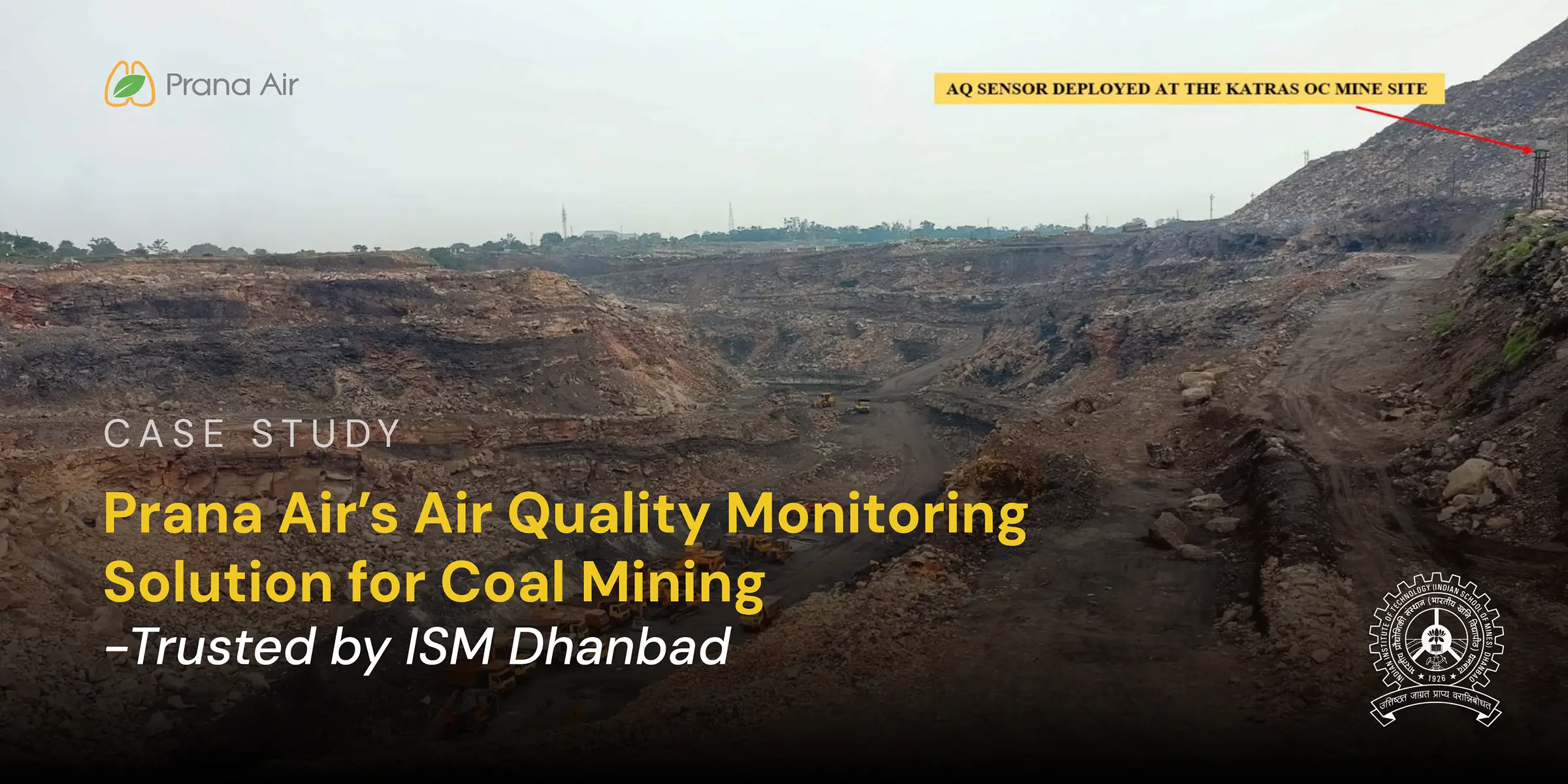
Department of Mining Engineering, Indian Institute of Technology (ISM), Dhanbad. An operational open-pit coal mine in Jharia, Dhanbad, India, known for its active coal production and frequent coal fires.
Mining Operations:
The mine has been active since 1990, with five coal benches and seven overburden benches. As a result, the area experiences high dust activity, vehicle movement, and blasting events.
Monitoring Points and Sensor Placement:
Prana Air’s Ambient Lite air quality monitors installed at three strategic locations to capture pollutant dispersion across different zones:

- Mine Site (Industrial Zone): Direct pollution source zone.
- Buffer Zone (Residential, GM office): Situated approximately 1.5 km from the mine.
- IIT–ISM Dhanbad Campus: Located 12 km away, a green belt area with dense vegetation, serving as a control zone.
Why Real-Time Air Quality Monitoring Matters in Coal Mining?
- Coal mining is a major source of particulate matter (PM) and toxic gases, significantly contributing to air pollution in the surrounding environments.
- As a result, exposure to fine particles like PM2.5 and PM10 can lead to serious health risks, including respiratory and cardiovascular issues.
- To address these concerns, environmental regulations now mandate continuous air quality monitoring and reporting to ensure safer and compliant mining operations.
- However, traditional monitoring methods are often slow, manual, and resource-intensive, limiting their effectiveness in dynamic industrial environments.
- Therefore, modern IoT-enabled air quality monitoring solutions provide a transformative alternative, enabling real-time data collection, automated reporting, and faster decision-making for effective pollution control.
What is Prana Air’s Air Quality Monitoring Solution For Coal Mining?
4 Advanced Ambient Lite Air Quality Monitors

It is a multi-parameter monitoring system that measures PM2.5, PM10, CO, SO₂, NO₂, O₃, and other critical ambient air pollutants, while providing real-time data output. As a result, it is ideal for large-scale industrial operations that require reliable and continuous air quality monitoring.
Monitored Parameters:
The devices measured a broad spectrum of air quality and climate metrics:
- Particulate Matter: PM1, PM2.5, PM10
- Gaseous Pollutants: CO, CO₂, SO₂, NO₂, O₃, TVOC
- Environmental Factors: Temperature, Humidity, Rainfall, Noise Levels
Each device recorded data every minute, which was then aggregated for hourly and daily analysis. Furthermore, all data was transmitted in real time via cloud-connected web and mobile dashboards, allowing for seamless remote access and continuous monitoring.
Technology Highlights:
- Minute-by-minute data collection with real-time transmission.
- Data accessibility and visualisation via cloud-connected web and mobile dashboards, enabling remote monitoring.
- Multiple communication protocols, including GSM, UART, WiFi and RS-485 ensure network flexibility and integration.
Insights from Monitoring: Pollution Across Zones
To explore the complete findings and environmental insights from this deployment, click here to access the full case study.
Prana Air’s air quality monitoring solutions for coal mining identified a clear pollution gradient:

- The mine site exhibited the highest pollution intensities.
- Residential and office buffer zones showed moderate levels.
- The green campus area recorded the cleanest air quality, benefiting from natural vegetation and distance.
The real-time monitoring also revealed patterns in pollution related to mining operations and environmental conditions. Including daily peaks corresponding to blasting and vehicle activity and meteorological influences such as temperature inversion and humidity.
How Prana Air’s Technology Supports High-Resolution Monitoring that Is Ideal for Institutions?

- Research-Grade Accuracy:
Measures a broad range of pollutants, including PM1, PM2.5, PM10, CO, CO₂, SO₂, NO₂, O₃, and TVOCs. Along with it, meteorological factors such as temperature, humidity, noise, and rainfall. - Precision Sensors
Utilises laser-based 90° light scattering for particulate detection, combined with advanced electrochemical gas sensors. As to deliver accurate and reliable measurements suitable for both scientific research and regulatory compliance. - Robust & Enduring Performance
Built for harsh and high-dust environments, because these air quality monitors engineered for long-term, uninterrupted operation, ideal for coal mines, institutional labs, and academic research settings. - Real-Time Data Access
The cloud-connected platform enables live data streaming, interactive dashboards, and historical data analysis, supporting real-time decision-making and regulatory reporting. - High Sampling Frequency
Captures data at one-minute intervals, allowing for the detection of short-term pollution spikes such as those caused by blasting or machinery — essential for timely environmental interventions in dynamic mining zones.
Practical Applications and Operational Benefits with Air Quality Monitoring Solutions for Coal Mining
From the actionable data provided by Prana Air’s monitors, mines have implemented:
- Dust suppression techniques, including dry fog and wet sprays.
- Physical controls like enclosure of dust-generating equipment and vegetative buffer zones.
- Optimised blasting schedules responsive to real-time pollution alerts.
- Maintenance protocols to minimise machinery emissions.
The integrated alerting system allows mining operators to act immediately on threshold breaches, enhancing worker safety and regulatory compliance.
Institutional and Research Use of Prana Air Monitors
- Academic and Institutional Deployments: Devices extensively used at IIT–ISM Dhanbad and similar institutions for both indoor and outdoor air quality research. And it enables epidemiological studies, environmental policy research, and student training activities.
- Research-Grade Monitoring
Prana Air monitors are known for their precision and reliability. As a result, many environmental science and engineering labs use them. Because of their cost-effective and scalable alternatives to traditional research equipment. - Long-Term Robustness
Thanks to their durable design and low maintenance needs, these monitors well-suited for long-term monitoring projects across both industrial and research applications. - Networked Research
Moreover, multiple devices can easily be connected to create larger institutional or regional sensor networks, making them ideal for wide-scale environmental monitoring initiatives.
Conclusion: Technology That Empowers Safer Mining and Smarter Research
Prana Air’s Ambient Lite air quality monitors are more than industrial tools — they are enablers of academic insight, environmental responsibility, and operational transparency. The successful deployment at ISM Dhanbad highlights their value in both mining zones and educational ecosystems.
Whether for real-time alerts, academic research, or long-term pollution studies, Prana Air provides the technology backbone needed to make air quality monitoring actionable, scalable, and impactful.