
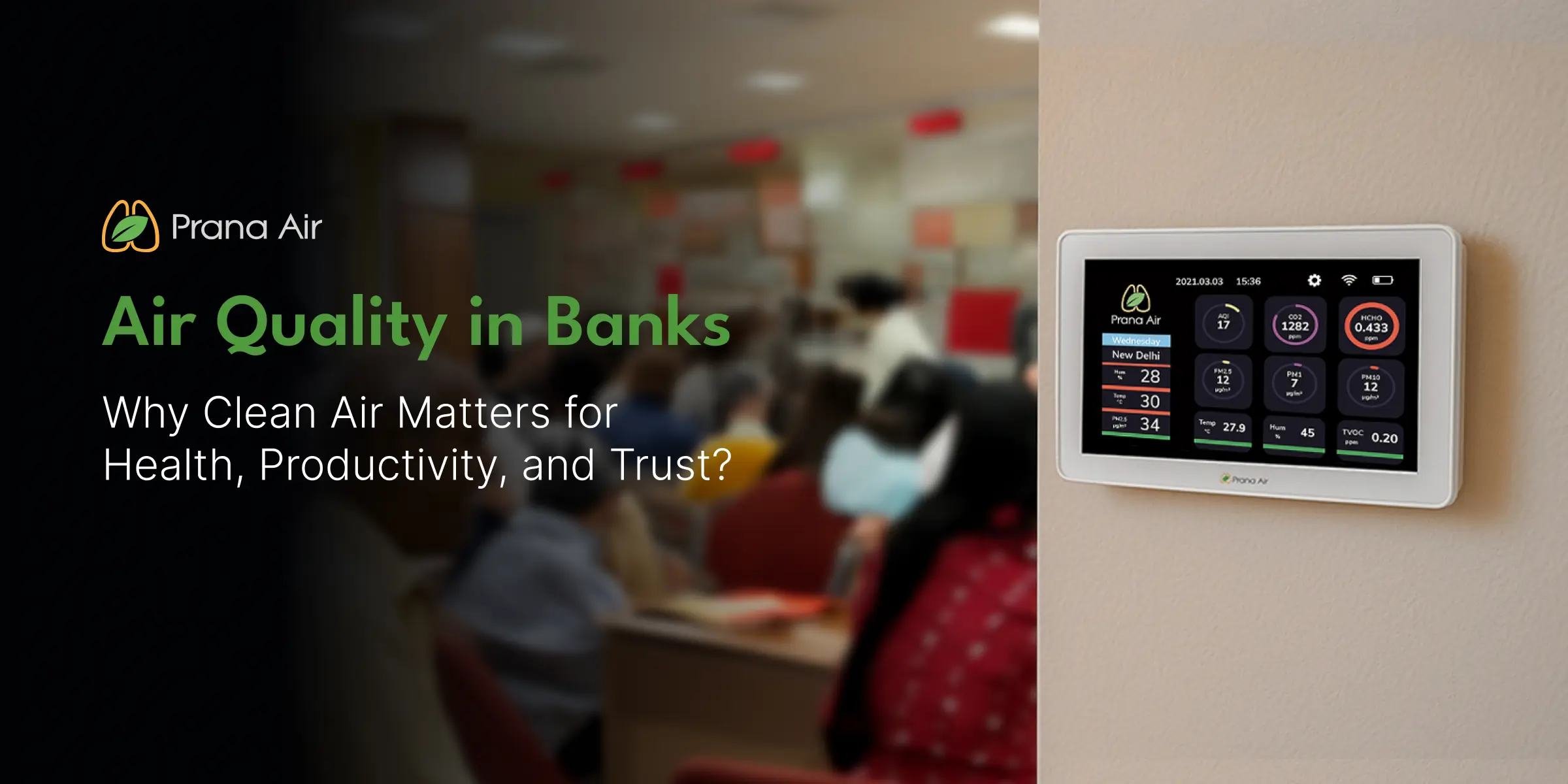
When people think about banks, the first things that come to mind are money, security, and trust. Customers expect safe transactions and reliable services. Employees expect a professional workplace. But there’s one factor that quietly shapes all these experiences: air quality in banks. More concerning issues persist where outdoor air quality levels remain unhealthy, as in Delhi, Gurgaon, Noida, etc.
Unlike visible issues such as long queues or poor customer service, indoor air pollution is silent and invisible. Yet, it affects everyone, from tellers who spend hours behind counters to customers waiting for their turn. In this blog, we’ll explore why indoor air quality monitoring in banks is essential, the dangers of ignoring it, and how Prana Air’s advanced solutions can transform banking spaces into healthier, more productive environments.
The Overlooked Risk: Poor Air Quality in Banks
Banks are enclosed environments. With constant foot traffic, reliance on air conditioning, and limited fresh air circulation, pollutants accumulate quickly. Dust, PM2.5 particles, volatile organic compounds (VOCs) from furniture and cleaning supplies, and elevated CO₂ levels from human presence all contribute to a polluted indoor atmosphere.
Employees often spend eight or more hours inside these spaces. Customers may only spend 30 minutes, but even that brief exposure can affect how they feel. When the air feels heavy, stale, or suffocating, it not only creates discomfort but also damages trust. Imagine discussing a home loan or investment in a space that doesn’t feel fresh; however, it sends the wrong signal about professionalism and care.
How Poor Air Quality in Banks Affects People?

Impact on Employees
Bank staff are among the most affected by indoor air pollution in offices. High CO₂ levels reduce concentration and decision-making ability. Fine particles like PM2.5 can cause fatigue, eye irritation, and even long-term respiratory issues. Many employees unknowingly suffer from Sick Building Syndrome—a cluster of symptoms like headaches, nausea, and dizziness that appear when working in poorly ventilated buildings.
Impact on Customers
For customers, comfort is key. A fresh-smelling, well-ventilated branch leaves a lasting impression, while stuffy air or odours can make people want to leave faster. Since banks are built on trust and confidence, even small discomforts can affect how safe and valued customers feel during transactions.
Impact on Banks Themselves
Poor air quality can lower staff productivity, increase sick days, and hurt customer satisfaction scores. It can also put banks at risk of non-compliance with indoor air quality standards such as WHO and ASHRAE. In an era where ESG (Environmental, Social, and Governance) commitments matter, ignoring air quality can impact both reputation and sustainability goals.
What the Data Reveals About Indoor Air Quality in Banks?
Recent studies have confirmed the scale of the issue:
- A ResearchGate study (2024) revealed that bank branches with split AC systems often recorded CO₂ levels exceeding safe limits, proving ventilation was inadequate.
- MDPI research linked high concentrations of PM2.5 and VOCs in bank offices with a rise in symptoms of Sick Building Syndrome among staff.
- A SensusAir pilot project (2025) in an African bank found elevated benzene, formaldehyde, and particulate matter, demonstrating how poor air circulation creates long-term health risks and affects overall workplace safety.
This data makes it clear: the problem of air quality in banks isn’t hypothetical because it’s measurable, visible, and urgent.
Solutions: How to Improve Air Quality in Banks?
The good news is that air quality challenges can be solved with the right tools. Banks don’t have to settle for invisible risks; with Prana Air’s air quality monitoring and purification solutions, financial institutions can transform their indoor environment.

Real-Time Monitoring with the Sensible+ Air Monitor
The Prana Air Sensible+ Air Quality Monitor acts as the first line of defense. With a 7-inch LED touchscreen, Wi-Fi connectivity, mobile app support, and a powerful 5000 mAh battery, it continuously measures pollutants like PM2.5, PM10, CO₂, VOCs, CO, temperature, and humidity.
For banks, this means managers can see, in real time, whether the indoor air is healthy or hazardous. Instant alerts allow quick action as like adjusting ventilation or activating purifiers, and before staff or customers even notice discomfort.
Squair Indoor Air Quality Monitor: Accurate & Reliable
The Squair IAQ Monitor provides research-grade accuracy at an affordable cost. Perfect for ATM areas, branch manager cabins, or meeting rooms, Squair keeps a constant eye on CO₂, PM2.5, and VOC levels. It helps banks identify hidden air quality issues in spaces that are often overlooked, preventing problems before they escalate.
Cair+ Indoor Air Quality Monitor for Smart Insights
For banks that want compact yet powerful monitoring, the Prana Air Cair+ IAQ Monitor is an ideal solution. Sleek and easy to install, Cair+ tracks the most important indoor pollutants in real time, delivering data directly to mobile apps or dashboards. It’s perfect for customer-facing areas, where both staff and visitors benefit from improved awareness of air quality. By turning invisible threats into visible data, Cair+ empowers banks to take corrective actions before comfort or health is compromised.
Cleaner, Fresher Air with the Fresh Air Machine: Not an Ordinary Air Purifier
Monitoring is critical, but purification is equally important. Prana Air’s Fresh Air Machine brings in outdoor air, purifies it using multi-layer HEPA filters, and releases it back indoors at 99.5% purity. This keeps oxygen levels balanced while removing harmful particles and odours.
In a banking hall, this translates to fresher, more breathable air that boosts customer comfort and helps employees stay energised throughout the day.
Transparency with Dashboards and Apps
Prana Air doesn’t stop at monitoring and purification. All devices connect seamlessly to mobile apps, web dashboards, and even in-branch TV displays. This real-time visualisation makes air quality transparent—not just for staff, but for customers too. Imagine walking into a bank and seeing a screen that shows today’s indoor air quality index (IAQI), it instantly reassures visitors that the institution cares about their health and safety.
Why Prioritising Air Quality in Banks Makes Sense

Better Employee Health and Productivity
When the air is clean, employees feel more alert, make fewer mistakes, and take fewer sick leaves. Studies show that improving air quality can increase workplace productivity by up to 10%.
Stronger Customer Experience
Customers may not analyze pollutant levels, but they can feel the difference between stale and fresh air. A comfortable environment builds confidence, making clients more likely to stay longer, engage more, and return.
Compliance and ESG Readiness
Global air quality standards are becoming stricter. By investing in monitoring and purification, banks not only ensure compliance but also strengthen their sustainability credentials.
The Future of Banking Can Be Fresh and Healthy
Air quality in banks is no longer just a comfort issue; it’s a business priority. Clean air directly impacts health, productivity, customer trust, and compliance. The question is not whether banks can afford to improve indoor air quality, but whether they can afford not to.
With Prana Air’s Sensible+ Air Monitor, Fresh Air Machines, and real-time dashboards, banks can create spaces where employees thrive, customers feel cared for, and institutions live up to their reputation for safety and reliability.
Final Thoughts
We may not see it, but we all feel it. The air we breathe inside banks carries invisible consequences for our bodies, minds, and confidence. By addressing the challenge of indoor air pollution, banks can create environments that truly reflect their promise of security and trust.
Learn more about Prana Air’s tailored air quality solutions for banks and financial institutions here: Prana Air – Bank & Financial Institutions Solutions.